Nano-technology – the technology which is going to exist in the future world. The scope of micro-technology has reached to the saturation level which has lead to the price reduction of Electronics products as rarely innovations can be done at this level. This has laid a ground for the upcoming technology – nano-technology.
In simple words, the Physics says technique using 10-9 range comes under nano-technology which is invisible when seen from our naked eyes as it is regarded as the smallest entity used in discrete format. The engineering world has different names while using this technique of Quantum Physics. The Mechanical Engineers (ACTM, Palwal) take this technology as ‘Quantum Mechanics’ while electronics Engineers (AITM, Palwal) take this technology as QCA (Quantum Cellular Automata) or Nanotechnology.
Use this technology for realizing logic circuits is the best way to catch up with the pace of running world and their requirements. Using this QCA technique, we can have following advantages:
- Reduction in size of the chips,
- Increment in clock frequency,
- Increase in speed,
- Reduction in power consumption.
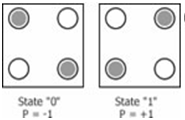
This QCA technology is a replacement of CMOS technology, proposed by Lent et. Al. Here, Cellular automata are implemented through quantum dots. In digital world, our representation is via’0’ or ‘1’ of the complete data and here, we have QCA cells and their representation is somewhat this way:-
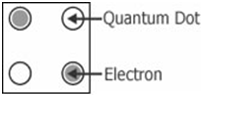
The filled dots showcase the two electrons. A square shaped nano-structure forms a simple QCA cell with four quantum dots. Ina cell, using Quantum Mechanical Tunneling mechanism, the two filled electrons are allowed to jump between the individual quantum dots. This tunneling is not inter-cellular and to prevent inter-cellular tunneling, gapping between the cells is done. These dots occupy opposite spaces satisfying their obvious nature of Columbic force of attraction. Proper dimensions are set for each cell and gaps between them.
For a simple wire, which will be used to carry information can be represented in the following way:
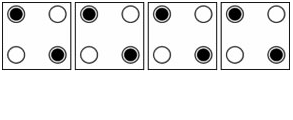
Simple wire formation
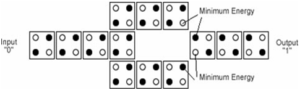
Implementation of NOT gate
In this way, any type of gate can be constructed using QCA technology and this designing can be achieved through QCAD (Quantum Cellular Automata Designer) which will work as a replacement of CMOS technology in the SILICON wolrld.