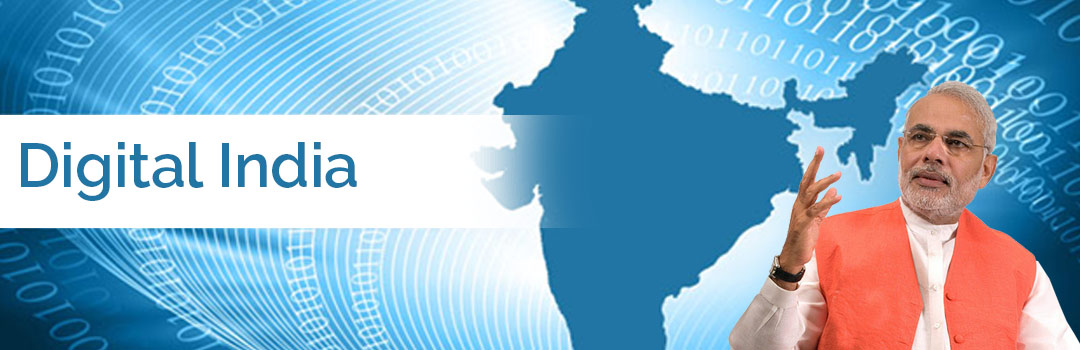
Digital India is an incredible campaign that was started by the Government of India in 2015. The Honourable Prime Minister Shri Narendra Modi inaugurated the Digital India campaign on the 2nd of July, 2015. There are three main aims of this campaign for the welfare and benefit of the citizens of India. These are the following: building up digital infrastructure for the Indian people, ensuring that services can be delivered and executed digitally, and making sure that Indian citizens are digitally literate. After these three aims, come the nine pillars or main aspects of the Digital India campaign. These have been identified as the following: e-Governance (reforming government through technology), information for all, IT for jobs, universal access to the internet, e-Kranti (electronic delivery of services), early harvest programmes, broadband highway, electronics manufacturing and public internet access programme.
The Digital India campaign is a collective effort, spearheaded by the Department of Electronics and Information Technology (DeitY). However, the cooperation of other ministries such as the Ministry of Communications & Information Technology, the Ministry of Human Resource Development, the Ministry of Health & the Ministry of Rural Development is needed. The benefits of the Digital India campaign are expected to be far reaching, and thus require all the important ministries to be stakeholders in its efforts. The programme is slated to benefit the entire 1.3 billion population of India, spread across all its states and union territories.
The campaign is expected to be completed in 2018. It is currently being funded through differentiated budget allocations to different Ministries and Agencies of the government. The entire campaign will need Rs. 113,000 crores to be executed. New structural changes will be introduced by the government to support the successful execution of the Digital India campaign. The National Informatics Centre (NIC) will be called in to provide assistance to different government departments and agencies. Some new jobs will also be created to lead the charge of the campaign. In major ministries, a new post called Chief Information Officer (CIO) to ensure that the programmes within the campaign are completed efficiently and on time.
If we look at the first major aim of the Digital India campaign, it is to build up digital infrastructure for Indian people. This is a very important aim as it will connect millions of unconnected Indians to the internet. As we know, the internet is a very powerful source of knowledge and information that has the ability to change and transform lives. Through the Digital India campaign, the government will bring high internet connectivity to villages and small towns, where it is critically needed. Internet access will make people living in villages and small towns aware about job opportunities, educational opportunities, their legal rights and the schemes which they can avail.
The second aim of the Digital India campaign is to ensure that services can be delivered and executed digitally. If this aim is achieved successfully, then it will lead to a paradigm shift in how the citizens of the country interact with government institutions to avail services. Digitization of services, using information technology will drastically reduce corruption and under the table bribing of government officials that is so prevalent in villages and small towns. Digital access to bank accounts through mobile phones will empower people to make urgent financial transactions quickly and easily. This will also make it easier to do business transactions by leaps and bounds. People will also be taught how to access a common service centre near their homes.
The third aim of the Digital India campaign is to make sure that people are digitally literate. If people are digitally literate, then they become empowered to get their problems resolved through the digital medium. They can also connect to one another online, through email and social networks. They can share the on-ground situations and problems through the online medium. Issues which are shared through the online medium gain visibility and they are resolved faster. The digital literacy programme is expected to reach at least 6 crore rural homes by 2018. Even corporates like Gmail, MS Office and Rediff Mail are on board. They have shown their cooperation towards the provision of e-mail addresses in regional languages, instead of English.
Thus, through the above mentioned measures, the people of India can expect to fulfil their dreams and potential by becoming a part of a new and empowered Digital India.