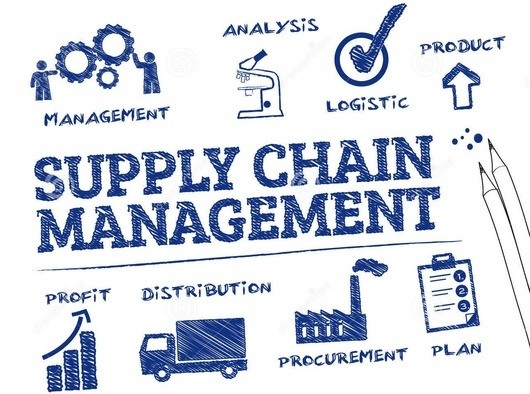
Supply Chain
A supply chain is really a complex, dynamic supply and demanding network.
A supply chain is a system of activities, organizations, income, information, and people involved in affecting a product or service from supplier to client. Supply chain actions involve the transformation of, raw materials, natural resources, and components into a finished product which is delivered to the end client. In difficult provide chain systems, used goods may re-enter the supply chain at any position where residual value is recyclable.
Overview
Supply Chain Management encompasses the preparation and supervision of all activities concerned with sourcing and conversion, procurement, and all logistics supervision activities. Notably, it also includes management and teamwork with channel partners, which can be intermediaries, third-party service providers, suppliers, and customers. In spirit, supply chain organization integrates supply and demand organization within and across companies. Supply Chain organization is an integrating function with primary duty for linking major business functions and business processes within and diagonally companies into a solid and high-performing business model. It includes all of the logistics management activities renowned above, as well as developed operations, and it drives skill of processes and activities with and across marketing, product design, finance, sales, and information technology.
Management
A German paper factory gets its daily supply of 75 tons of ecological paper as its raw material
In the 1980s, the name supply chain management (SCM) was urban to express the need to add the key business processes, from end user during original suppliers. Original suppliers are those that offer services, products, and information that add prices for customers and other stakeholders.
If all related information is accessible to any related company, every company in the supply chain has the capacity to help optimize the entire supply chain rather than to sub-optimize based on a confined interest. This will escort to better-planned generally production and distribution, which can cut costs and offer a gorgeous final product, leading to better sales and improved generally results for the companies involved.
Resilience
In recent studies, resilience, as “the attitude of a supply chain to cope with vary”, is regarded as the next stage in the evolution of conventional, place-centric project structures, customer-centric structures that allow people to work anytime, anywhere.
Resilient supply networks should support its plan and operations to adjust to risk that affects its capacities. There are 4 levels of supply chain spirit. First is rash supply chain organization. Second is internal supply chain addition to intended buffers. Then, came teamwork across the extended supply chain networks. Lastly is a dynamic supply chain edition and flexibility.
Recent research suggests which supply chains can also give compact flexibility.
Social responsibility
Incidents like the 2013 Saver building subside with more than 1,100 victims have led to common discussions about business social responsibility across total supply chains. Wieland and Hadfield (2013) advice that companies need to audit products and suppliers and that supplier auditing need to go further than direct relationships with first-tier suppliers.
Traceability in agricultural supply chains
Many agribusinesses and food processors their source for raw materials from smallholder farmers. This is mainly true in certain sectors, such as sugar, cocoa, and coffee. Over the past 20 years, there has been a shift towards more perceptible supply chains. Rather than purchasing crops that have been approved through several layers of collectors. Due to this, firms are now sourcing openly from farmers or trusted aggregators.
Regulation
Supply chain security has happened to be chiefly important in recent years. As a result, supply chains are a lot subject to the global and local system. In the US, several major regulations emerged in 2010 that had a permanent impact on how global supply chains operate. These new systems include the Importer Security Filing (ISF) and extra provisions of the Certified Cargo showing Program.
Development and design
With growing globalization and easier admittance to alternative products in today’s markets. The importance of creation design for generating demand is more important than ever in adding, as supply. Therefore competition among companies for the restricted market that requires increases in pricing. Other marketing elements suit less individual factors as product design. It similarly plays an, unlike role by providing attractive features to make the demand. In other words, it is the ability of a product’s design to produce demand by satisfying customer prospect.